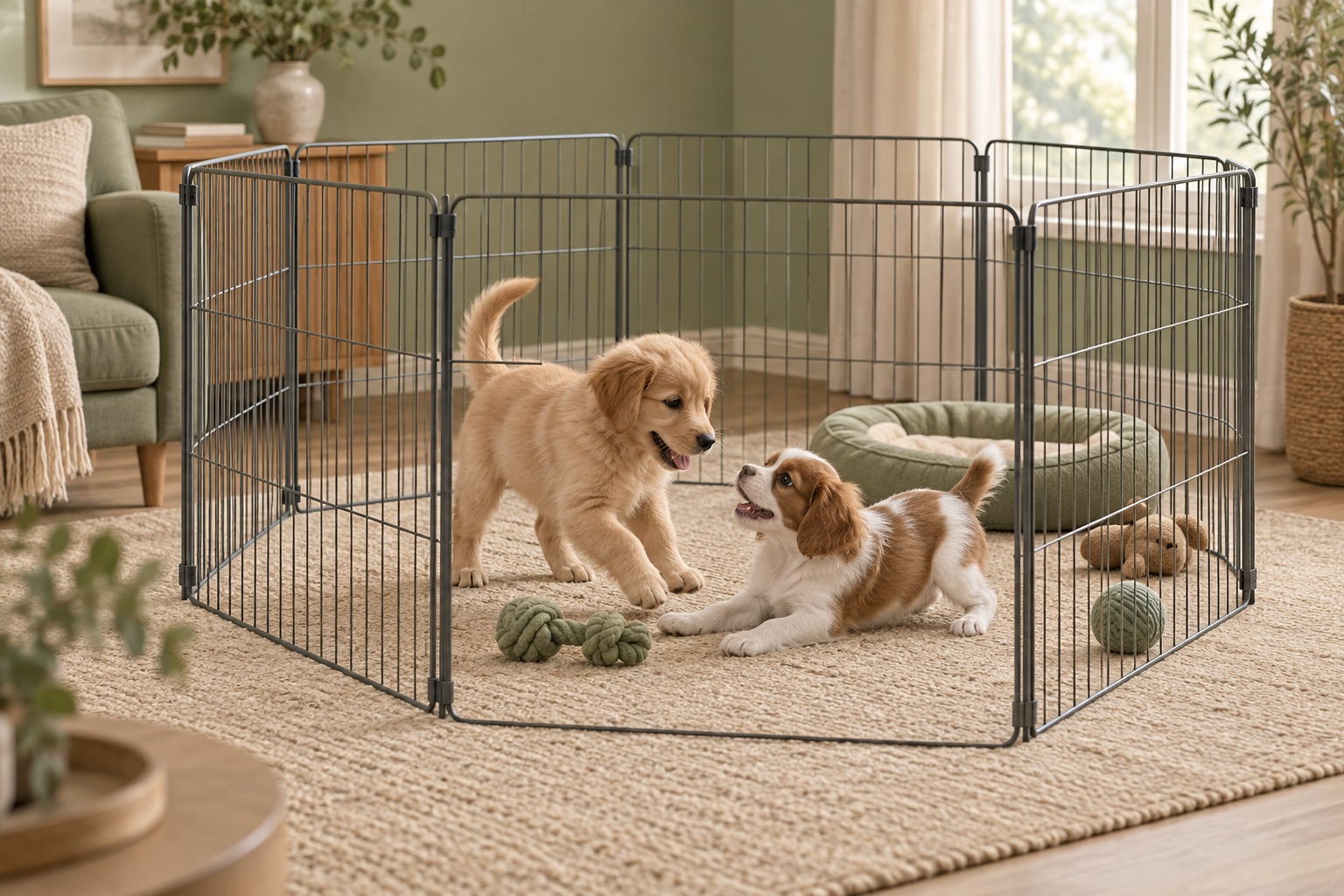
A playpen's customer just brought a puppy home. That buyer reads reviews like safety reports, and regulators treat containment products with growing attention. Safety is not a marketing layer on this family — it is the product. Here is the design-spec picture, the compliance paperwork that should travel with your orders, and a checklist that keeps both honest.
Design specs that prevent injuries
- Bar spacing (wire): sized so neither head nor muzzle can wedge — a spacing spec you should see in writing, not infer from photos
- Edge finish: rolled or capped wire ends and rounded panel corners; burrs are a lawsuit with fur
- Latch security: double-action latches that paws cannot learn; the latch is the most-copied, least-tested part in the family
- Panel stability: base width and connector locks that resist the 'toddler test' — an enthusiastic puppy hitting the panel at speed
- Mesh grade (fabric pens): claw-resistant weave and reinforced seams, as on our foldable pet playpen 99332
- Height by breed profile: jumpers clear low pens; publish the height and the breed guidance honestly
Metal panel systems like our metal pet playpen 2520 — 4/6-panel modular formats — carry the containment load for medium and large breeds, and their spec sheet reads like small furniture: gauge, coating, connector count. Fabric pens read like soft goods: denier, seam construction, zipper cycles. Both spec styles belong on the product page, because your retail buyer will ask for exactly those numbers — and because our compliance support starts from the published spec rather than reverse-engineering it after a question.
Compliance paperwork that travels with orders
Containment products sit in a regulatory gray zone in many markets — no single global 'playpen standard' exists — which is precisely why documented diligence matters. The working set: material declarations relevant to REACH and California Prop 65 for coatings, fabrics and plastics; coating safety data for powder-coated wire; small-parts and sharp-edge checks documented at final inspection; and carton drop-test records for e-commerce lanes. Where your market adds specific requirements — labeling language, warning texts, retailer vendor manuals — those attach to the same file. Our three-gate inspection process is what turns that list from a promise into a paper trail, and the importer-side view is in our quality checklist guide.
Merchandising safety without fear
Safety sells in this family, but the register matters. Listings that scare underperform listings that specify: publish the spacing, the gauge, the latch cycle count and the coating declarations, the way our spec sheets do for the metal and fabric playpen lines. Retail buyers — the professional gatekeepers for this category — read specific numbers as vendor maturity, and vendor maturity is what gets you onto their planogram alongside the compliance file.
- State spacing and height per model, with the breed-size guidance band the numbers support
- Publish the latch mechanism type — 'double-action' means something; 'secure' means nothing
- Attach coating and material declarations to the listing file, ready for retailer vendor manuals
- Show the panel connector in the listing photo set: the part your customer's puppy will test first
- Keep the compliance file current per production batch so reorders inherit the paperwork, not the archaeology
The buyer's checklist for this family
- Spec sheet with spacing, gauge or denier, height and latch model — in writing, per SKU
- Physical sample subjected to the puppy test: lean on panels, work the latch with a paw, run a hand over every edge
- Coating and material declarations collected at order time, not at loading
- Latch and connector cycle counts on the pre-production sample
- Photo report before balance payment showing packed cartons and panel condition
Program shape is simple here: fabric pens capture the small-dog and travel side of the puppy moment; wire pens own containment for growing breeds. One of each at a 300-piece MOQ, boxed with honest breed guidance, covers the demand curve — and the reorder usually arrives with the puppy's growth spurt, which is the most reliable calendar in the pet category.