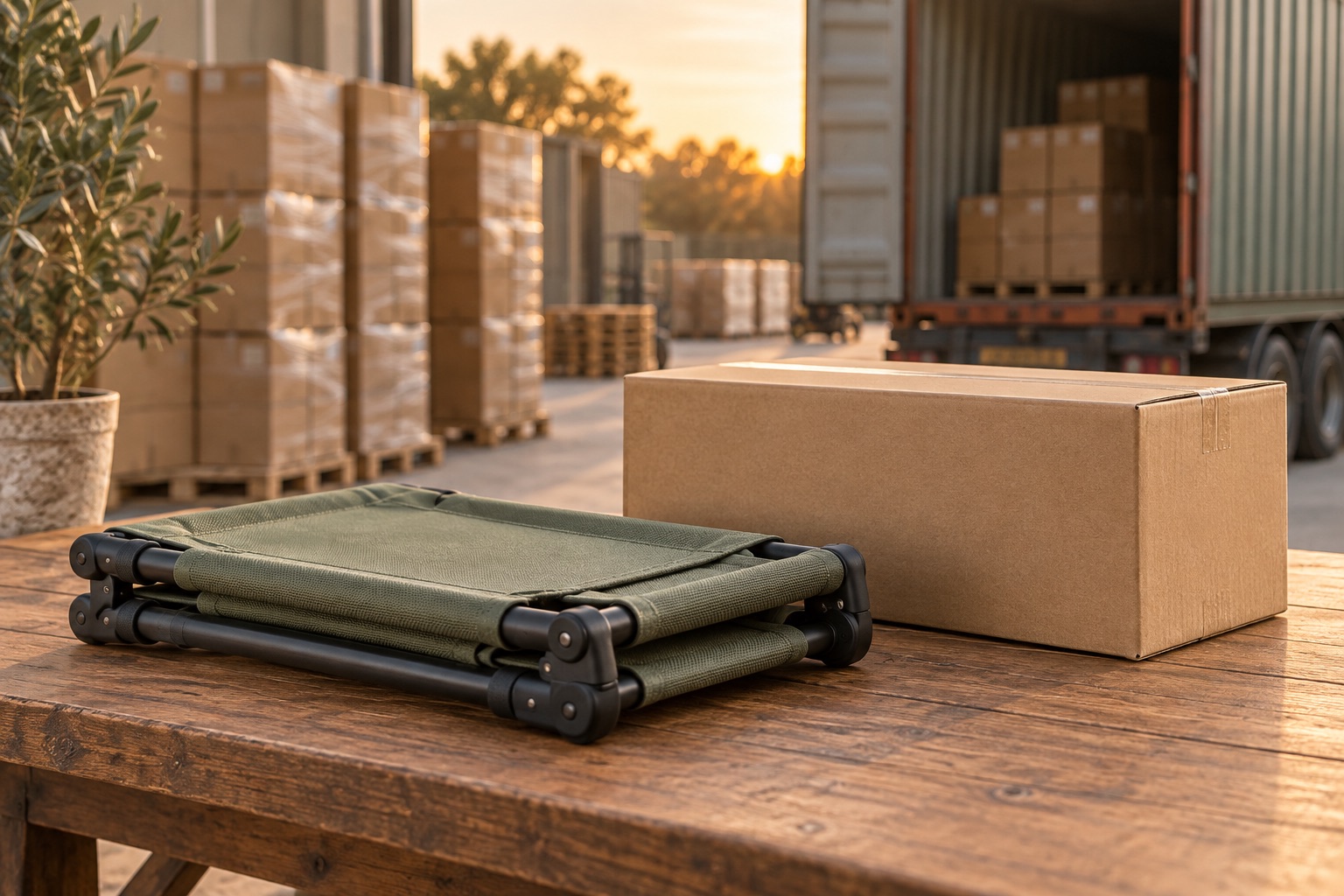
Packaging is the most underestimated cost line in pet product sourcing. It is quoted as an afterthought, then it fails three tests at once: the drop test in the container, the shelf test in the store, and the unboxing test in the review section. This article walks the three packaging systems that cover nearly every pet product program — export cartons, retail-ready, and FBA/private label — and where each one earns its cost.
System 1: the export carton (do not skip its homework)
Standard export packaging — fold-flat product in a poly bag inside a double-wall carton — is the default for good reason: it is cheap, dense and repairable. Its homework is the drop test. A carton that survives a warehouse in Shenzhen and a last-mile parcel network is engineered, not assumed: edge crush for stacking, drop height for parcel lanes, and internal fit so the product cannot migrate. Carton drop tests are available on request in our production process precisely because e-commerce lanes are rougher than wholesale lanes. Note the economics: better carton specs cost cents per carton and save entire orders — a failed packaging spec is repacking 300 pieces by hand at destination, which nobody prices honestly until they pay for it.
System 2: retail-ready (color boxes and shelf logic)
Retail-ready packaging is a print program: color boxes, insert cards, hang tags, product photography, barcodes. It earns its keep where the shelf does the selling — pet stores, garden centers, chain retail — and it carries four cost layers buyers should quote separately: print minimums (color boxes typically run in thousands per design), freight volume (a color box can double a carton's cbm — the packed-volume lesson from our cost structure guide applies with interest), damage rate (printed surfaces show scuffs that plain cartons hide), and artwork discipline (dielines, barcode mapping and language variants approved before mass print). Our packaging customization follows the same pre-production sample lock as the product itself: the box is approved physically, not by PDF.
System 3: FBA and private label cartons
Amazon FBA packaging is a compliance exercise with a margin payoff. The requirements are mechanical — FNSKU labels over barcodes where required, poly-bag thickness and suffocation warnings, carton weight and dimension limits, case-pack configuration — and the payoff is that your soft crate or elevated bed lands sellable without a prep center's margin. Private label adds the brand layer: your logo on the product label, the box and the insert card, with model mapping checked against your SKU list so the right SKU ships in the right box. The customization depth available across our catalogue — from the woven label on a raised cot to the printed height guide on a pet stair — is documented on each product page's customization list.
Choosing between them
- Wholesale and chain retail: retail-ready boxes; budget print minimums and accept the freight volume
- E-commerce own-store: export cartons with upgraded inner fit; invest the savings in unboxing inserts
- Amazon FBA: FBA-compliant cartons plus a minimal brand layer — label and insert, not a full color box
- Mixed channels: export carton as the base with a retail sleeve added per channel — one production run, two shelf faces
One integration note: packaging choices interact with payment and inspection. Carton specs belong on the quotation, artwork sign-off belongs with the pre-production sample, and the pre-shipment photo report should show packed goods — the same inspection gate that protects your balance payment also protects your packaging decisions.
The unboxing layer: reviews are packaging
For e-commerce channels, a third surface matters beyond carton and shelf box: the unboxing experience that ends up in review photos. This is not about luxury — it is about instruction clarity, part organization and first-impression tidiness. An elevated bed that opens with a numbered parts kit, a tool included where assembly needs one, and an instruction sheet readable at 11pm earns stars that no product feature can buy. A soft crate that opens smelling of factory chemistry and packed in shredded chaos loses them in the same way.
- Instruction sheets: numbered steps, real illustrations, destination-language printing as an OEM option
- Part organization: hardware bags taped to the frame, not loose in the carton
- First-touch layer: a poly bag with ventilation holes and a clean inner divider — cheap, and it photographs
- Insert card: warranty language, care instructions and a reorder QR code on one card
- Odor control: material choices and airing time specified for enclosed products like crates and carriers
The takeaway
Packaging is a product decision wearing a logistics costume. Spec it on the quotation, drop-test it before mass print, approve it physically on the PPS, and let it carry your brand where the shelf — physical or digital — actually happens. Suppliers who talk about cartons without being asked are usually the ones whose products survive the journey.