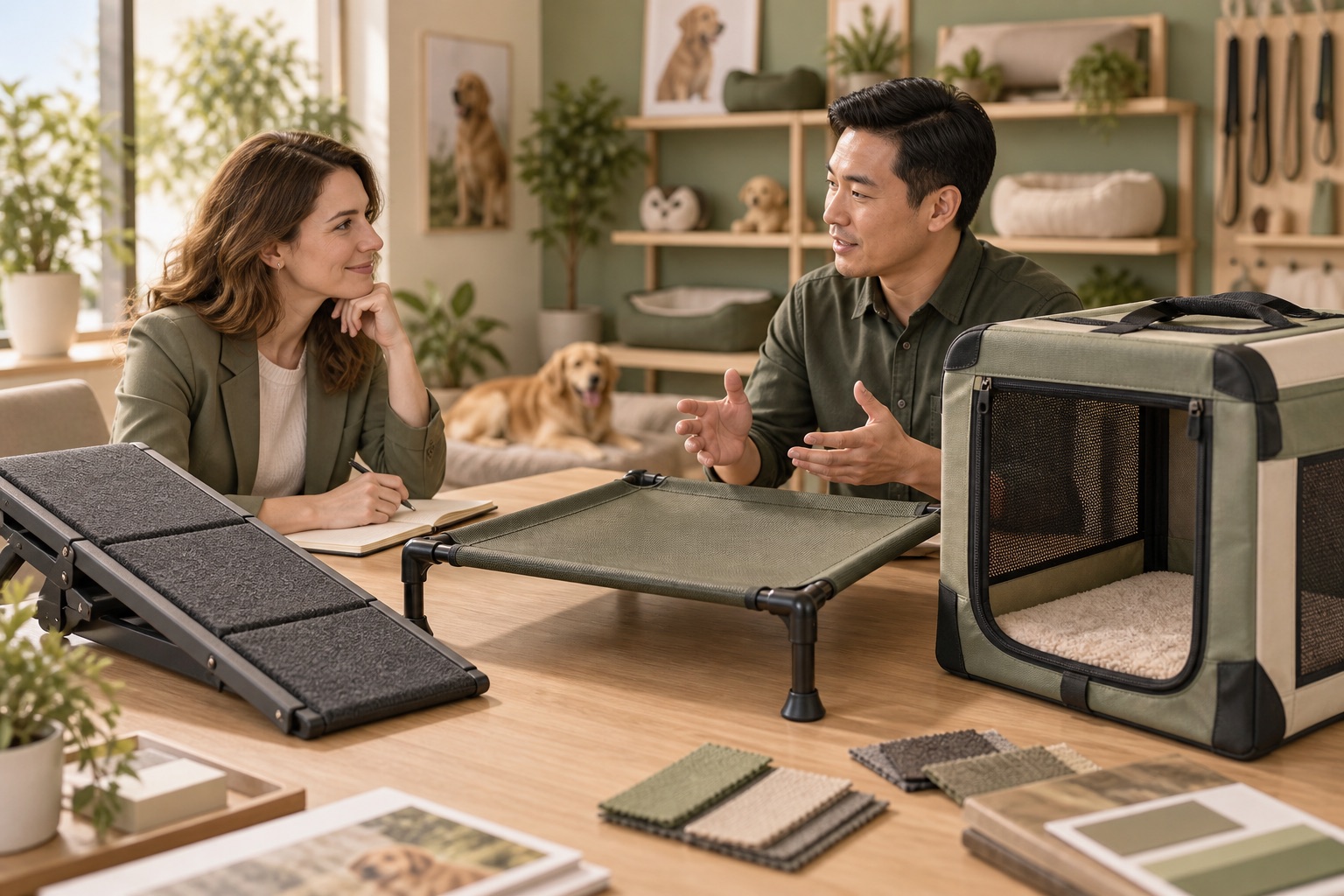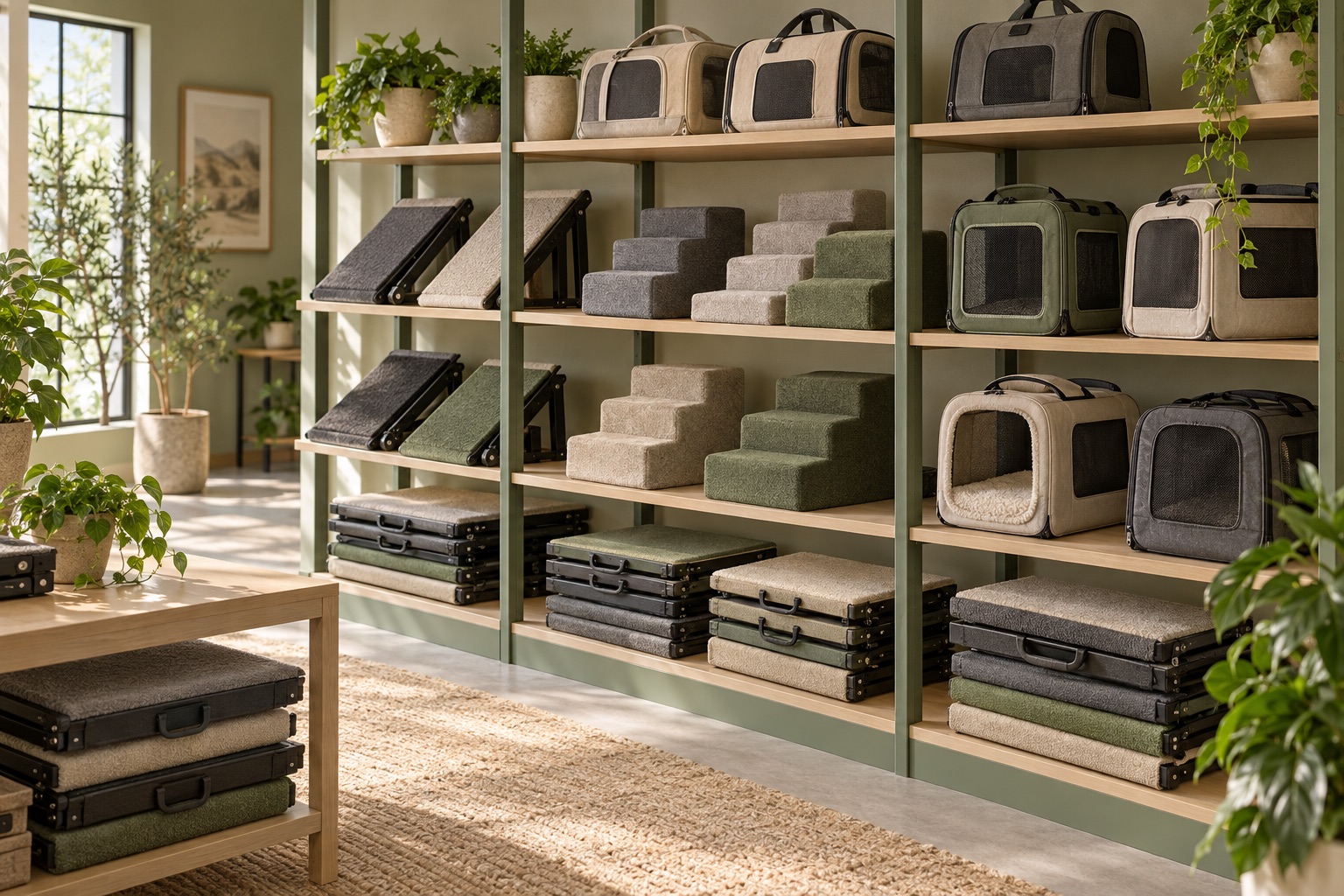
'China pet supplies wholesale' covers hundreds of subcategories, but four families carry most retail volume: elevated beds and cots, ramps and stairs, crates and playpens, and tents and carriers. This guide maps what each family contains, what MOQs are realistic, and how pricing tiers work — so you can read a quotation the way the factory wrote it.
Category 1: elevated beds and cots
The raised-cot family runs from 48 cm cat cots to 141 cm XL rectangular beds, and it is the easiest family to private label because the spec sheet is short: frame, fabric, size. Steel-framed textilene cots such as our mesh elevated pet bed 2310 anchor the volume end; canopy versions like the canopy elevated pet cot 2506 carry summer margins; plush and faux-fur models such as the faux fur nest bed 2518 serve gifting seasons. Stocking logic: one fabric, three sizes, then expand on reorder data. Browse the full family on our elevated beds category page.
Category 2: ramps and stairs
Mobility products sell on load rating and tread, not on color. A usable range covers car access — a 190 cm ramp such as our foldable car pet ramp 2401 — plus home access in stair form, from a four-step unit like the four-step foldable pet stair 777 to six-step aluminum stairs rated 70 kg such as the aluminum foldable pet stair 778n. The category pairs naturally with senior-dog marketing, which converts better than generic pet content. See the ramps and stairs category page for the full 19-model spread.
Category 3: crates and playpens
Soft crates run S-3XL and win on fold-flat shipping; the classic foldable soft pet crate 911 shows the full size ladder in one model family. Playpens — fabric like the foldable pet playpen 99332 or panel metal like the metal pet playpen 2520 — capture the puppy first-purchase moment. This is also the most e-commerce-driven family, so FBA-ready carton labeling is a customization worth specifying early. The crates and playpens category page lays out the options.
Category 4: tents and carriers
The outdoor family — pop-up kennels such as the portable pet tent crate 2512, camping cots, wheeled carriers like the rolling soft pet carrier 2524 — is the most seasonal. Buyers who sample in autumn and land cargo by February capture the spring reset; buyers who start in spring sell in autumn at markdown. Treat this family as a calendar decision first and a product decision second.
Where MOQs actually start
For these four families, a 300-piece per-model MOQ at standard colors and packaging is the realistic factory-floor baseline in 2026 — it is what we run, and it is what a genuine manufacturer can sustain without hiding a reseller margin. Below that, you are paying a stock-holder premium or accepting mixed leftovers; far above it, you should be negotiating tooling and exclusivity instead. Customization shifts the number: new Pantone colors ride fabric MOQs, retail packaging adds print minimums — the mechanics are the same across suppliers, so a quotation that hides them is the problem, not the number itself. Our MOQ, samples and lead times page states our terms exactly and explains what moves them.
The three pricing tiers behind every quote
- Stock or catalogue tier: standard spec, standard packaging, fastest lead time, lowest price — this is where first orders belong
- Customized tier: your logo, colors or packaging on a catalogue platform — same tooling, modest setup cost, priced openly
- Development tier: ODM geometry, new molds or exclusive colorways — quoted against a project plan with sample milestones
Most bad sourcing outcomes come from tier confusion: a buyer expects tier-2 customization at tier-1 pricing, or pays tier-3 prices for what is actually tier-2 work. When you compare quotes across suppliers, confirm which tier each price belongs to before comparing the numbers — and quote at least two trade terms (FOB against CIF, for example) so freight assumptions are visible rather than buried. Our wholesale cost guide walks a full worked example on an elevated-bed first order.
Category economics: which family funds which
Beyond the spec sheets, the four families behave differently as a portfolio. Elevated beds are the volume foundation: broad size ladders, year-round demand, and the most private-label-friendly spec sheet in the category. Ramps and stairs are the margin specialists — lower unit volumes, but buyers shopping for a specific problem (a senior dog, a high SUV) are less price-sensitive and return less when the load rating is honest. Crates and playpens ride the puppy economy: high lifetime value per customer who then buys beds, stairs and travel gear. Tents and carriers are the seasonal accelerant — the highest ceiling per SKU and the hardest calendar.
A practical first-year structure for a general pet retailer: beds as the always-in-stock spine, one ramp and one stair SKU for the mobility margin, crates for the customer-acquisition moment, and a two-SKU outdoor capsule timed to spring. That mix puts roughly 70% of your cash into predictable replenishment and 30% into seasonal upside — and every SKU in it is available at a 300-piece MOQ from the same supply base, which is what keeps the logistics one container at a time.
The takeaway
Wholesale pet supplies from China is a spec-sheet business wearing a lifestyle-photo costume. Pick a family, learn its three or four load-bearing specs, anchor your MOQ expectations at 300 pieces per model, and force every quote to declare its tier and trade term. Suppliers who make those declarations easy are telling you how the whole relationship will read.