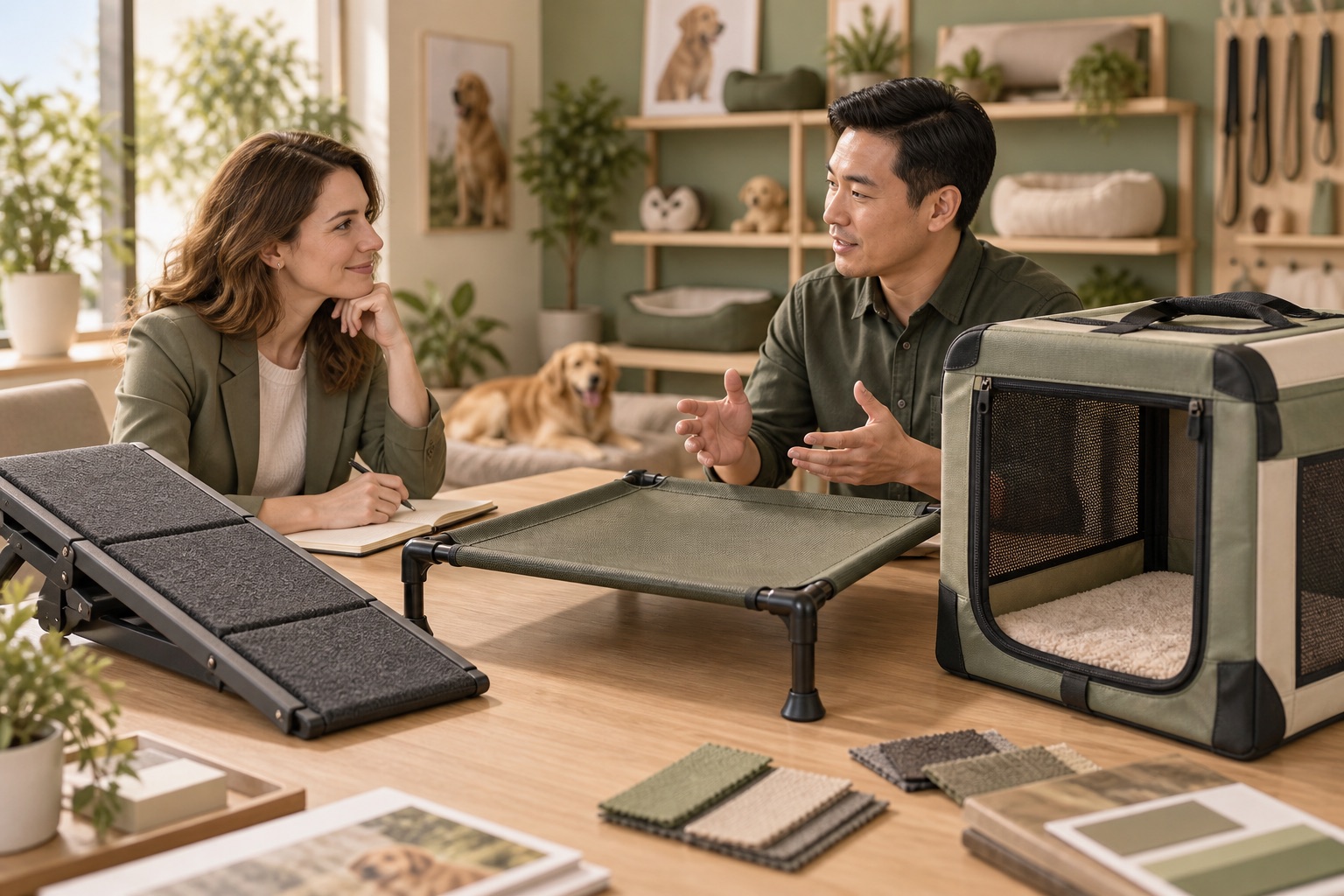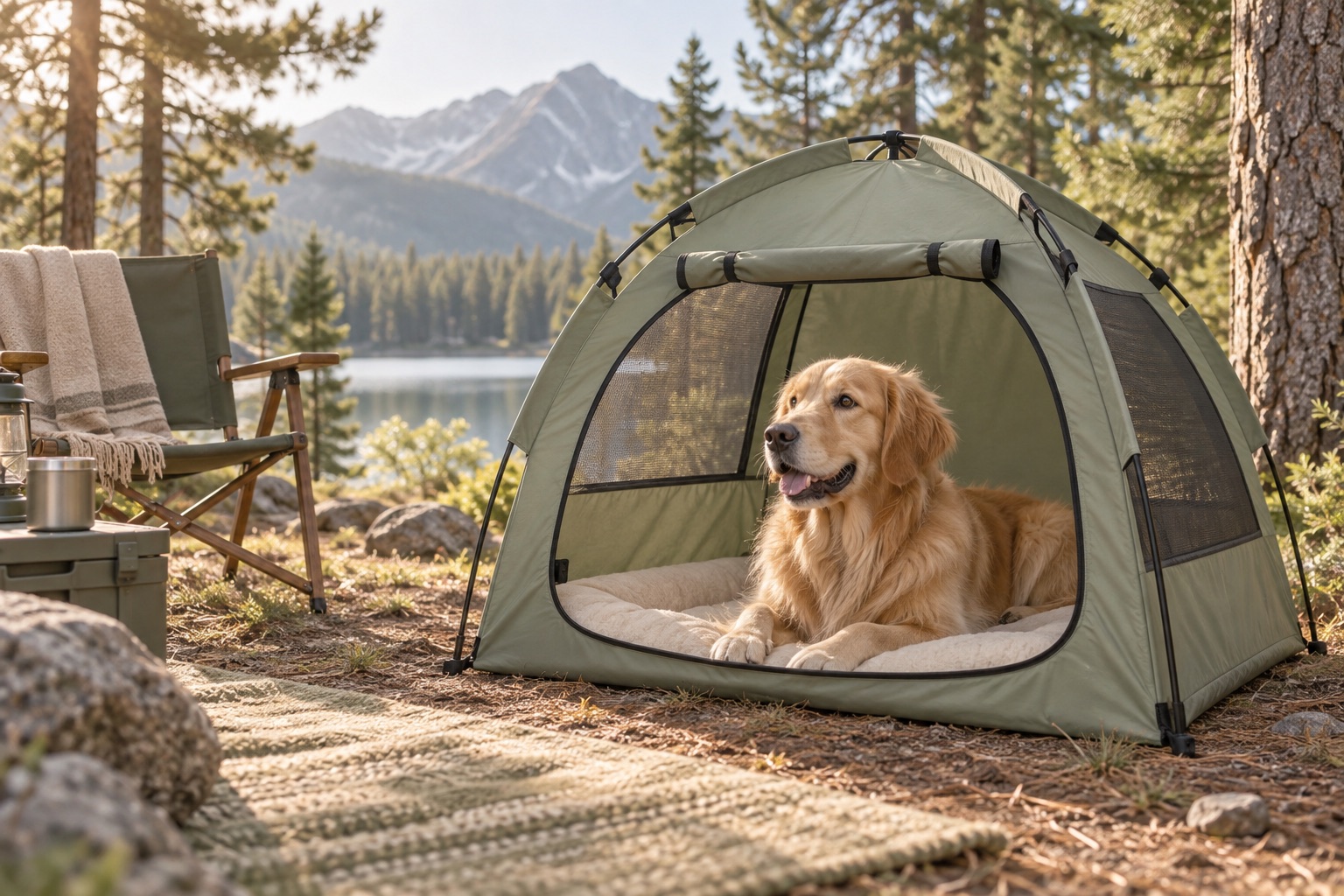
The outdoor pet segment — tents, camping cots, travel carriers — grows faster than the category average because it borrows demand from two trends at once: human outdoor recreation and pet humanization. It also punishes late programs harder than any other family: miss the spring reset and your tent SKUs age six months in a warehouse. Here is the segment mapped for buyers.
What's in the segment
Three sub-families cover it. Pop-up tents and kennels: instant-setup shelters like our portable pet tent crate 2512 — 118 x 120 cm of footprint at 2 kg, the segment's volume anchor. Camping furniture: cots and chairs scaled for dogs, such as the foldable camping pet chair KTY03 and its bed-top variant, plus camo-pattern cots like the KTY01 for the hunting-adjacent niche. Travel carriers: wheeled soft carriers like the rolling carrier 2524, twin-compartment crates like the double carrier 2523, and car-specific gear such as the hanging booster seat 2517. The tents and carriers category page lays out all nine models with packed dimensions.
The three specs that matter outdoors
- UV and fabric spec: canopies and shells need UV-resistant coatings with a stated denier; outdoors, fabric failure is the return, not the zipper
- Frame joints: pop-up geometry lives and dies at the joints; cycle-test the open-fold mechanism on the sample, then again on the pre-production sample
- Pack weight and fold: campers read grams the way buyers read FOB — publish pack weight and folded size on the box, and keep them honest
The camo sub-niche deserves a note: it prints well in oxford, converts on pattern recognition rather than feature lists, and pairs with the hunting-dog accessory buyer who spends across a whole program, not a single SKU. Print development is an ODM track task — bring the brief and the sample round prices it — as described in our OEM/ODM comparison guide.
The calendar is the product
Work backwards from your market's season start. Retail resets 6-8 weeks before peak; cargo needs 30-45 days of production plus freight weeks; sampling needs 2-4 before that. For a northern-hemisphere spring reset, the brief lands in October and the sample approves by December — which is why the buyers who ask about tents in August own the shelf in March. Autumn exists too: carriers and booster seats ride the year-round travel lane and cushion the seasonality of tents and cots, which is one more reason the sub-families ship in the same container.
Channel fit: who buys outdoor pet gear
The outdoor family sells through three distinct channels, and each reshuffles the sub-families. Outdoor and camping retailers convert tents and camp furniture best — their customers already own the human version, and pet SKUs ride the same seasonal reset and the same demo instinct. Pet specialty converts carriers and booster seats year-round, because the trigger is the vet visit and the car ride, not the season. General e-commerce converts the whole range on search, where spec-rich listings — pack weight, setup seconds, UV denier — outperform lifestyle photography alone. A program that knows its channel weights its three sub-families accordingly instead of splitting evenly by default.
There is also a bundling economy worth planning at order time: tent plus camping cot plus carrier share fabrics, frames and webbing in production, which is why mixed-SKU containers of this family price well per unit — the components concentrate. Buyers who isolate one outdoor SKU for a trial often pay more per unit than buyers who take the coherent three-SKU capsule, an unusual economics that rewards the segment's natural shape.
Program shape for a first season
Anchor the season on the pop-up tent (volume, price accessibility, demo-able in store), add one camping cot for margin, and one carrier for year-round carry-over — three SKUs, 300 pieces each, one outdoor brand layer. If the season lands, the second container adds the camo line and the wheeled carrier; if it disappoints, the carrier SKU carries on into winter travel. The segment rewards exactly the discipline our first-order planning guide describes: roles, not enthusiasm.