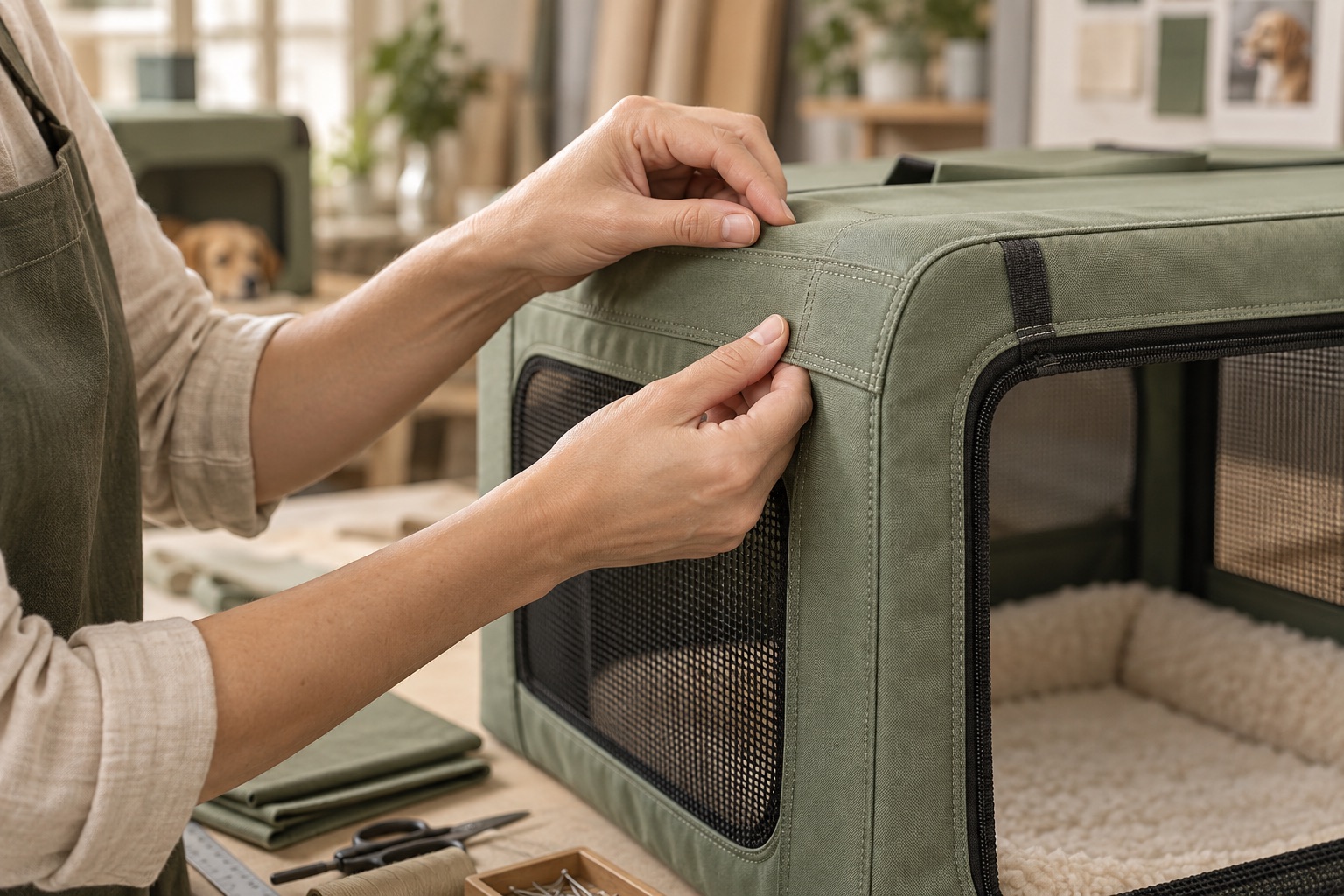
Every sourcing guide says 'work directly with the factory'. Few explain how to tell one apart from a trading company over email, and almost none admit that the answer sometimes does not matter. This article gives you eight questions that reliably expose the difference for pet products — beds, ramps, crates, tents — plus what to do with the answer once you have it.
Questions 1-3: establish what they actually make
Ask: 'Which of your catalogue models do you produce in your own workshop, and which do you outsource?' A factory answers with specific models and can go deeper — for instance, our 63-model catalogue splits into elevated beds and cots, ramps and stairs, crates and playpens, and tents and carriers, and a factory answer explains which of those families run on their own sewing and welding lines. A trading company answers with a category name and a promise of 'good quality control'.
Ask: 'Can I see that line running this week?' A real factory offers a live video call at production hours and walks you from cutting to packing without a script. Ask: 'What changed in your process after your last customer complaint?' Factories own failure stories because they fixed something specific; intermediaries deflect to 'our supplier is very responsible'.
Questions 4-6: probe the paper trail
Ask: 'What entity name appears on the invoice and the B/L, and does it match your business licence?' The invoice entity must match the licence; a mismatch means someone in the middle is reselling. Ask: 'Which export port do you ship from, and how far is it from your workshop?' Shenzhen factories ship from Yantian or Shekou with a few hours of trucking — if the port is 1,000 km from where the 'factory' claims to be, the goods are being consolidated from somewhere else.
Ask: 'Who pays for a failed pre-shipment inspection?' This is the accountability question. A manufacturer that runs incoming, in-process and pre-shipment gates on its own floor — as we document in our quality checklist guide — answers in one sentence: the factory reworks and re-inspects at its cost before anything ships. A company that has to chase a third party for an answer is telling you where you will be chasing when something goes wrong.
Questions 7-8: test the customization depth
Ask: 'If I change the fabric on this raised cot to a Pantone color, what is the minimum and what is the lead time impact?' A factory knows its fabric suppliers' MOQs and answers with numbers; our own answer for textilene and oxford programs is built into the quotation — a base MOQ of 300 pcs per model at standard spec, with custom-color adjustments priced openly. Ask: 'Can you develop from a sketch, and who owns the tooling?' ODM capability — engineering from a brief rather than reskinning a catalogue — is a factory trait, and the tooling ownership answer should already be written in their order confirmation, not invented on the call.
What to do with the answers
Score each supplier 0-8, one point per factory-grade answer. Five or more means you are likely talking to a manufacturer; two or fewer means a trading company — which is not automatically disqualifying. Trading companies add value in consolidation across categories and in markets where they hold stock. What matters is that the price, the QC accountability and the story all match the business model. Problems begin when a company claims factory pricing and factory accountability while adding an intermediary's margin and none of its own production control.
Two practical notes from the elevated-bed and crate categories. First, ownership can be layered: some 'factories' own sewing but outsource frame welding — acceptable, as long as they say so and inspect incoming frames. Second, the answers must be consistent across time: a supplier whose port, entity or workshop story changes between the first call and the third is giving you a red flag no single question would catch on its own.
A worked example: the same questions, two suppliers
To see the questions earn their keep, imagine running them on two candidates for a soft-crate program. Supplier A answers Q1 with model numbers and a video slot for Tuesday morning; Q4 comes back as 'the entity on the invoice is the entity on the licence, attached'; and Q7 returns a written note that custom colors ride the fabric mill's minimum, quoted openly. Supplier B answers every question within an hour, but the answers are paragraphs of reassurance with no numbers, the licence arrives with a different company name than the signature block, and Q8 gets 'tooling is discussed after the deposit'.
Nothing Supplier B said is disqualifying on its own. The pattern is what matters: speed without specificity, documents that almost match, and commercial terms deferred to after commitment. A buyer who scores the eight answers mechanically — one point per factory-grade answer — sees the pattern in ten minutes, and can spend the sample budget accordingly. That is the entire value of a written framework: it converts a gut feeling into a score you can defend to your own finance department.
The takeaway
You are not interrogating for moral purity; you are mapping accountability. Eight questions, asked in the first two emails, tell you who controls production, who inspects it, and who stands behind it when an inspection fails. Then the sample round confirms it: the approved sample must match the spec sheet, and the shipment must match the approved sample. Suppliers that welcome this process — ours included — should be measured by how specifically they answer, not by how quickly they promise.