Elevated beds look like the simplest product in the pet category — tube frame, fabric, done. That simplicity is exactly why first-time buyers get the cost math wrong: with so few components, every assumption (fabric weight, frame gauge, packed volume) moves the unit price more than newcomers expect. This article breaks down the cost structure the way a factory sees it, then does the MOQ arithmetic on a realistic first order.
What a quote is made of
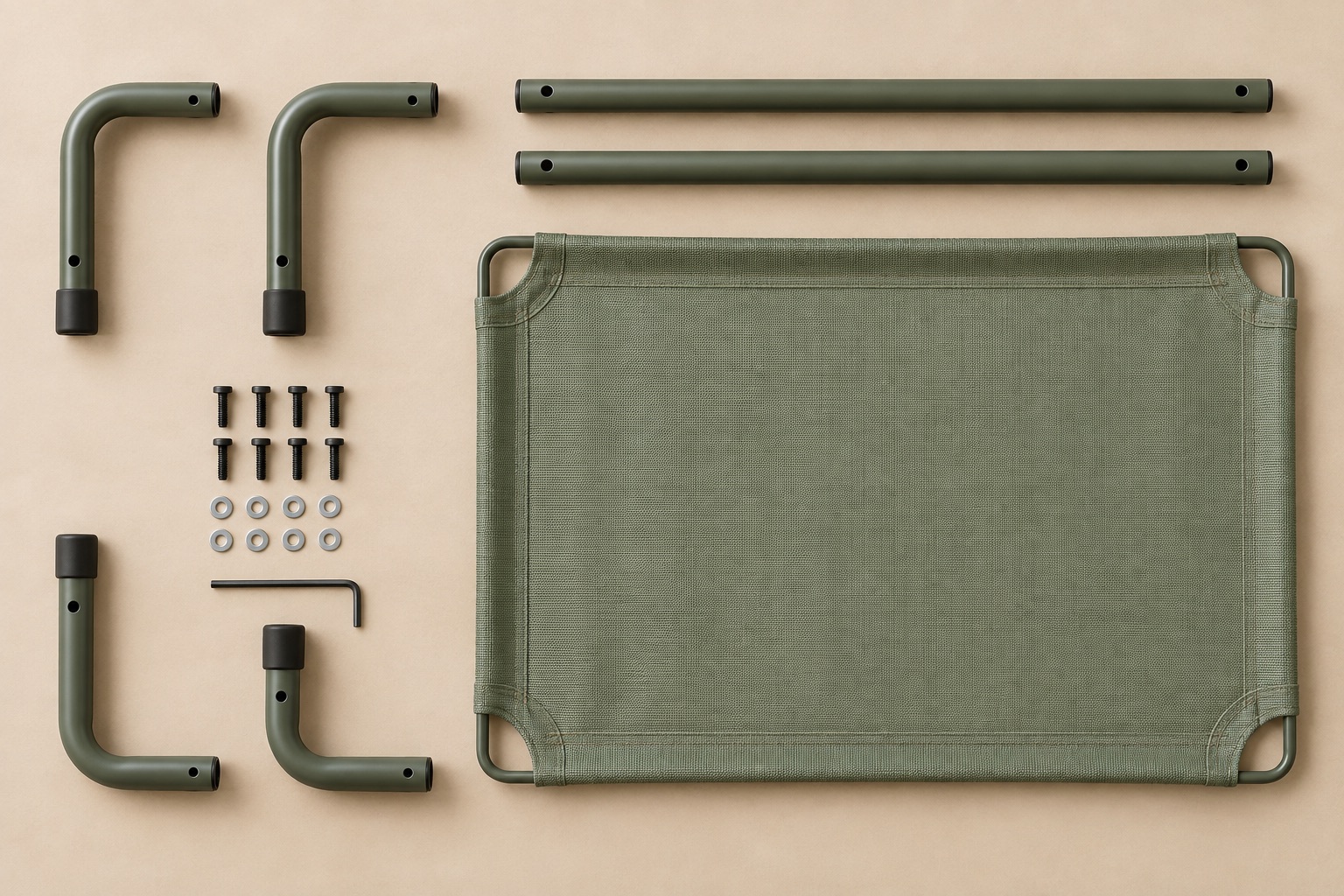
A raised-cot unit price has four blocks. Frame: steel tube gauge, powder coating and the welding/pre-assembly labor it implies. Fabric and sewing: textilene weight or oxford denier, thread, and seam construction — the largest quality-variable in the unit. Hardware and packing: screws, tools, instruction sheet, poly bag, export carton. Overhead: the factory's share of cutting efficiency, defect allowance and inspection. When you compare a volume anchor like our mesh elevated pet bed 2310 against a premium canopy unit like the canopy elevated pet cot 2506, you are mostly watching the fabric block and the packing volume change — the frame block is more stable than buyers assume.
This is why serious suppliers ask your retail price band before quoting. A USD 39.90 retail cot and a USD 79.90 canopy cot are different engineering targets, and a factory that quotes without asking is handing you a number that will be renegotiated by disappointment later.
MOQ math: the 300-piece first order
At a standard-spec MOQ of 300 pieces per model, the arithmetic for a mid-size textilene cot quoted at USD 11.80 FOB runs: goods USD 3,540; freight for roughly 6-8 cbm of folded cots USD 700-1,100 depending on lane and term; samples and courier USD 150-300. Total cash to first sellable inventory: about USD 4,400-4,900 excluding duty. The full worked example, including how to reverse-calculate your maximum purchase price from a target retail price and margin, is in our wholesale cost guide — the short version is that packed volume, not unit price, is where first-order budgets are usually lost.
Two planning rules follow. First, model choice is a cash decision: a cot that packs 20% flatter releases budget that buys your second SKU. Second, resist the four-size launch: one fabric in three sizes — S, M, L — at 300 pieces each outsells a six-SKU launch that strands 40% of your cash in slow sizes. Our elevated beds category page marks which models ladder cleanly from S to XL so you can plan sizes without guessing.
Where customization changes the numbers
Customization sits on top of the structure, and each layer has its own economics. Woven labels and heat-transfer logos cost little and do not move lead time once artwork is approved. Pantone-matched fabric rides the weave mill's minimum — sometimes it raises the effective MOQ, sometimes it just adds a week. Retail packaging adds a print run; drop-test the carton before mass print, because repacking a 300-piece order is more expensive than the test. None of this is a reason to skip customization — it is the reason customization should be quoted as a line, not absorbed into a fudge factor. The customization-approval flow is the same one described in our MOQ and lead times guide.
Reading a factory quotation line by line
With the cost blocks in mind, a serious quotation can be audited in two minutes. Check that each line names the model and size — a single 'elevated bed' price is a red flag. Check that fabric is specified by type and weight, not by color name. Check that the packing spec appears: folded dimensions and carton quantity per model, because your freight math depends on them. Check that MOQ, lead time and trade term are printed, and that validity is dated — quotes in this category typically hold for 15-30 days because fabric and freight both move.
Then compare two quotes on the same model from different factories, and look at what the gap does. A gap of 5-8% usually reflects overhead and defect-allowance discipline — the cheaper quote may be assuming a higher defect rate that you will inspect later. A gap of 20% or more usually means the two quotes are not selling the same product: different fabric weight, thinner frame gauge, or a missing packaging layer. The line-item structure exists to make those differences visible before the deposit, not after the container.
The takeaway
Elevated-bed economics reward boring discipline: publish your retail target, quote two trade terms, budget freight from packed volume, launch three sizes on one fabric, and lock every customization on a pre-production sample. A supplier who helps you do those five things is cheaper than a supplier who is 8% lower on the unit and silent on everything else. That is the standard our quotations are built to — test us on it.