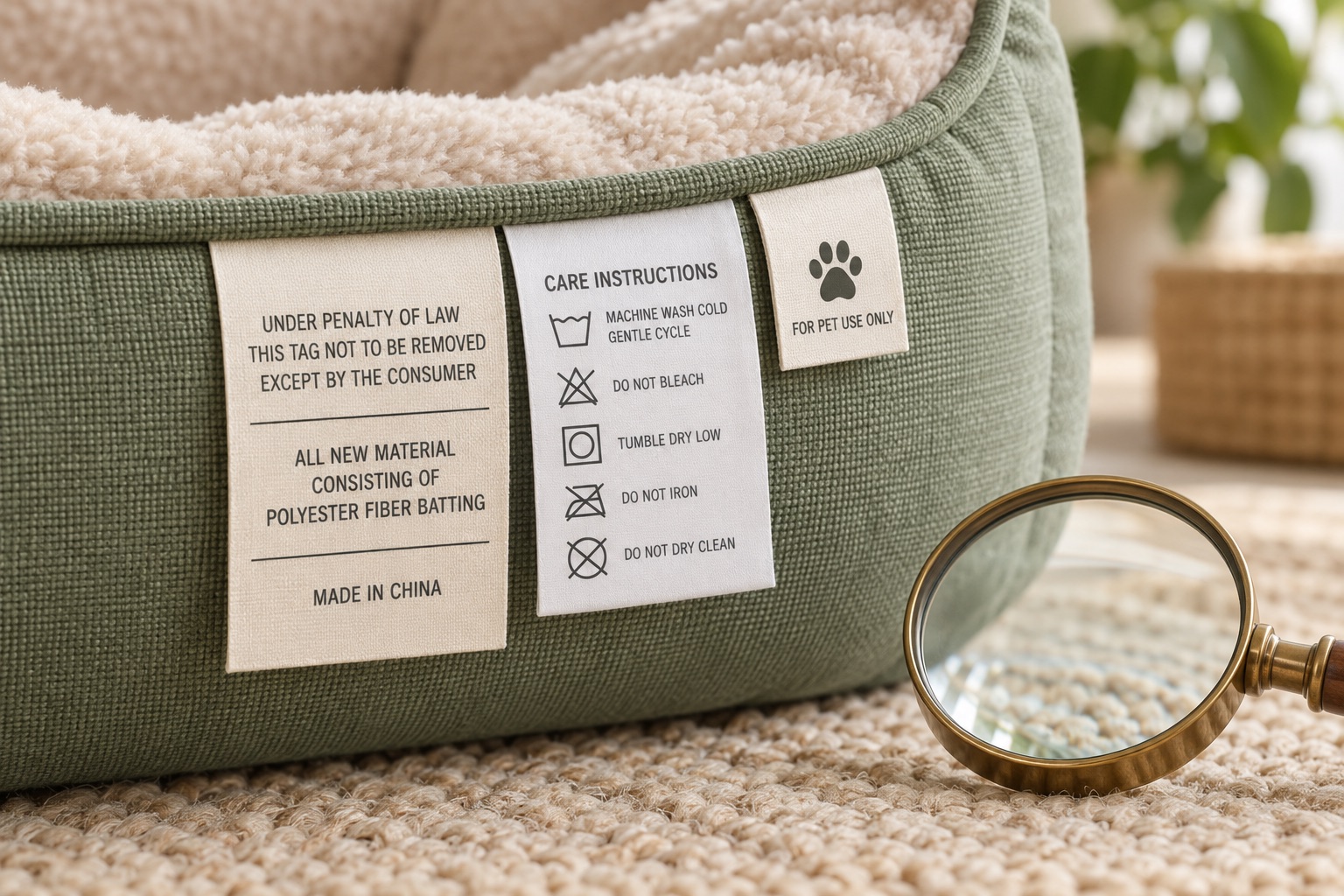
Pet products occupy a regulatory gray zone: no dedicated 'pet bed directive' exists in the EU, and no single federal pet-toy standard governs the US. New buyers read that as 'no rules'; experienced buyers read it as 'the rules come from neighboring product classes, retailer vendor manuals and your own documentation'. This article maps what actually applies to textile-and-metal pet goods — beds, ramps, crates, carriers — and the paperwork set that keeps a program defensible.
The EU: REACH, GPSR-adjacent duties and labeling
REACH is the load-bearing regulation for our materials: restriction lists for substances in textiles, coatings and plastics — the azo dyes and phthalates questions every serious EU buyer asks. Coated fabrics (oxford), PVC-coated weaves (textilene) and powder-coated steel frames are the surfaces where those questions land, and material declarations from the factory's supply chain are the normal answer. The EU's general product safety regime adds the horizontal duty that products be safe for consumers, with documentation to show it — for pet products this translates into design-risk notes (sharp edges, small parts, load claims) and traceable batch records. Labeling: fiber composition, care instructions and importer identity are the working minimum for textile goods, with warning texts where a product's design warrants them.
The US: Prop 65's long shadow and claim discipline
Federal rules specific to pet products are thin; California Prop 65 is not. Warning-letter exposure on phthalates and similar substances makes Prop 65 screening a standard question in US programs — the screening answer lives in the same material declarations REACH asks for, which is why the two markets share one testing budget when requested at order time. Beyond chemistry, the US risk is claims discipline: a '70 kg load rating' printed on a box is an advertising representation once it ships, which is why our load ratings are backed by batch static-load checks and why we ask buyers to carry tested claims forward rather than invent stronger ones for retail copy. Labeling basics — country of origin, fiber content, care, manufacturer/distributor identity — follow the general textile and customs rules.
The documentation set that travels with orders
- Material declarations for fabrics, coatings and plastics, requested at order confirmation — not at loading
- Partner-lab test reports against REACH / Prop 65 relevant substances where your channel requires them
- Spec sheet with published load ratings and dimensions — the document your label claims trace back to
- Inspection records: incoming, in-process and pre-shipment gates with photo reports
- Carton drop-test records for e-commerce lanes
- Batch traceability so a material question maps to a production window, not to a guess
Timing is the compliance skill most buyers learn late: documentation requested at order time fits inside the 30-45 day production window; documentation requested at loading becomes a two-week panic with a container waiting. Our compliance support starts from the published spec sheets across the catalogue — from crates to carriers — so the testing scope is defined before the deposit, and the three-gate inspection record lands alongside the goods.
Retailer vendor manuals: the compliance layer buyers forget
Beyond regulation, the strictest compliance document in a pet product program is often the retailer's own vendor manual. Chains specify labeling placement, carton marking, barcode quality grades, insurance minimums and test-report formats — and their receiving docks enforce it. A shipment that is legally compliant but fails the vendor manual can be refused or reworked at your cost. Importers who treat the manual as a compliance source at quotation time — mapping each requirement to the factory's inspection gates — avoid the expensive version of that lesson.
The workflow is simple to state: obtain the manual before the deposit; translate its requirements into spec-sheet lines, label proofs and inspection checkpoints; file the evidence with the shipment record. Factories already running documented three-gate inspection absorb this naturally — the manual becomes one more checkpoint list at the pre-shipment gate. Factories that resist written checkpoints have told you which kind of compliance program they can support, better than any certificate on their website.
The takeaway
The gray zone does not excuse anyone — it simply moves the burden to documentation. REACH and Prop 65 relevant material declarations, honest load claims, care and origin labeling, inspection records and batch traceability: six artifacts that cost little when planned and everything when improvised. Suppliers who volunteer them at quotation stage are telling you how the whole relationship will read — and how it will read if a regulator, or a retailer's vendor manual, ever asks.