Search 'top 10 pet products manufacturers in China' and you will find dozens of lists. Almost none of them tell you where the ranking came from, and most were written by the supplier that appears at number one. This article takes a different approach: instead of handing you names, it gives you the method a professional buyer uses to build and verify a longlist — so your top 10 is based on evidence you collected, not on someone's advertising budget.
1. Build the longlist: four sources that actually work
The goal at this stage is volume, not judgment. You want 20-30 candidate factories so that the verification funnel has something to filter. Four channels produce most of the list:
- B2B marketplace directories, filtered by 'manufacturer' rather than 'trading company' and by the product category you actually sell
- Trade fair exhibitor lists (Canton Fair, Pet Fair Asia) — published online months before the events, searchable by category
- Customs data platforms, which show which factories genuinely export to your market and at what volumes
- Reverse search: find strong retail products in your niche, then search the model numbers and materials to find who builds them
One filter matters more than any channel: category focus. A factory whose catalogue spans four pet families with coherent spec sheets — for example a range covering elevated beds, ramps and stairs, crates and outdoor tents — is structurally different from a generalist trading catalogue where every product photo looks like it came from a different factory. Category depth is the first thing we would ask you to check on any longlist, including ours: start from the product families and see whether the specs read like one factory or ten.
2. Score the website like a spec sheet, not a brochure
Your second filter costs nothing: read each candidate's product pages as a quality document. A manufacturer that can publish load ratings, frame materials, packed dimensions and MOQ per model has internal documentation — which usually means internal engineering and QC. A catalogue that lists only lifestyle photos and superlatives is hiding a decision you will have to make later with less information.
Concrete example from our own range: our foldable dog ramp 2501 states a 190 x 44 cm platform, an aluminum tube frame with 8.5 mm board, a 60-70 kg load rating and packed dimensions of 59 x 10 x 46.5 cm. Whether or not you buy from us, that is the level of detail your shortlist candidates should be able to match from their published pages before you ever email them. The same standard applies across families — compare a claimed S-3XL soft crate range against pages like our classic foldable soft pet crate 911 and see whether sizes, fabrics and door configurations are actually specified.
3. The first email is a test you design
Send the same email to all 20-30 candidates: your category, target quantity, destination port, and one technical question that cannot be answered from their website — for example, which denier oxford they use on a specific crate size, or how they verify the load rating of a 70 kg stair. Then score the replies:
- Response time within 24 business hours — export teams that cannot answer fast now will be slower after your deposit
- A direct answer to the technical question, not a catalogue attachment
- A quotation that states MOQ, lead time and trade term explicitly — vague pricing is a verified red flag
- Willingness to quote two trade terms side by side, which shows they understand landed cost rather than just unit price
This single round typically removes half the longlist. The suppliers that survive are worth 30 minutes of structured verification, which our supplier vetting guide turns into a repeatable checklist — licence checks, video factory walks, and sample discipline.
4. Verify with documents, not impressions
The difference between a shortlist and a gamble is documentation. Before any sample order, your final 2-3 candidates should each provide: business licence and export registration, the entity name that will appear on the invoice (it must match the licence), a live video walk of the production floor showing your product category in progress, and a pre-production sample policy in writing.
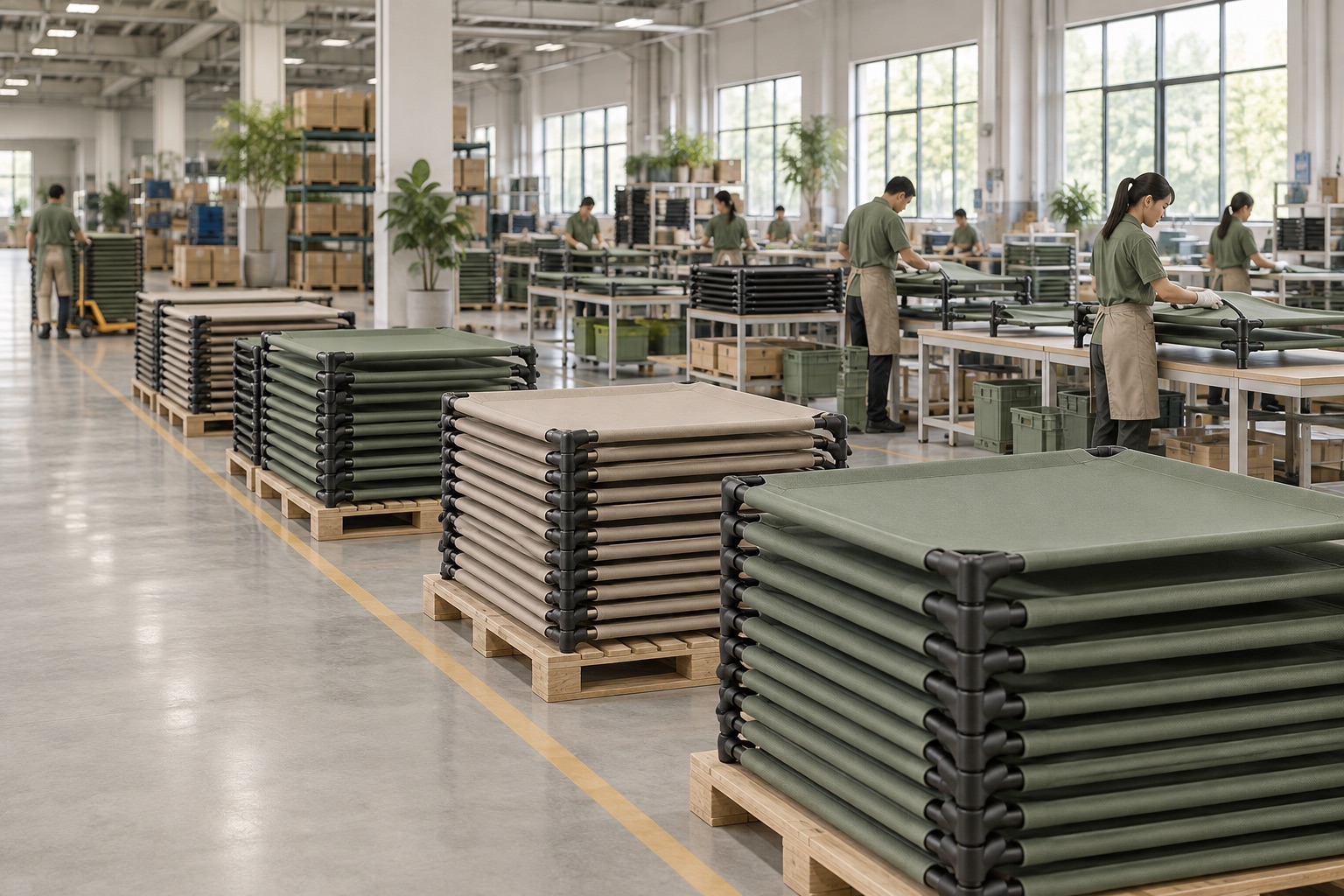
Pay attention to what the video walk shows between products. A genuine elevated-bed or pet-stair production floor has cutting tables, sewing lines and frame welding in one flow; an office with a sample shelf and rented footage is a different business model. Neither is automatically wrong — some trading companies are excellent — but you deserve to know which one you are dealing with, because it changes who is accountable when an inspection fails.
5. The sample round is the real ranking
Order the same reference model from your top candidates and compare the samples against four checkpoints: conformance to the published spec, seam and weld finish, packaging quality, and the paperwork that travels with the sample. The supplier whose sample matches its own spec sheet without prompting is the one whose mass production will match the approved sample. That discipline — spec sheet to sample to shipment — is exactly what our three-gate quality process is built around, and it is the closest thing to a predictive indicator this industry has.
The takeaway
A credible 'top 10' is not a list you read, it is a funnel you run: 30 candidates, 15 email survivors, 5 document checks, 3 samples, 2 suppliers worth a trial order, 1 partner you scale with. The method takes about two weeks of part-time work and it transfers to any product category. If you want to shortcut the longlist stage, our China pet products supplier overview shows what a fully documented shortlist candidate looks like — and we are comfortable being measured against the standard this article sets.